
On this page
Six popular approaches, with the missing cost restored
| Approach | What it changes | What it does not establish |
|---|---|---|
| Fixed ordinary stake | A consistent cost for each paid round | A positive expectation |
| Ante Bet | 25% higher spin cost; enhanced feature chance | A guaranteed feature or double profit |
| Buy Free Spins | 100× ordinary stake paid at entry | A minimum profitable return |
| Buy Super Free Spins | 500× cost and minimum 20× bomb in covered newer editions | A minimum cash win or recovery of cost |
| Increase after a loss | Larger exposure after previous losses | A better next-spin distribution |
| Wait for a dry spell | Which moments you choose to enter | That the next spin is due |
Fixed stakes make records interpretable
Keeping an ordinary stake unchanged makes the units in a session log simpler. A 20× return means the same amount on each ordinary round, and you can compare the full stake and return without separating a different size on every row. That is an accounting benefit, not an edge over the game.
If the ordinary stake is R2 and a session contains fifty completed ordinary spins, the total stake is R100. Suppose the sum of gross returns is R78. The sample net result is −R22 and sample return is 78%. Those figures are a worked example, not a dataset we collected. Counting only the winning spins would overstate the sample return.
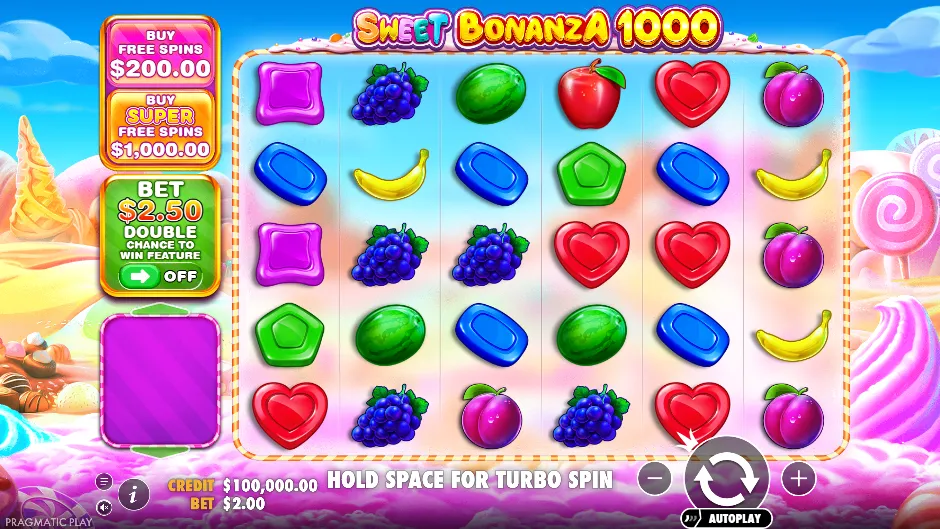
If you change the stake, record each actual debit rather than multiplying the final stake by the number of rounds. If you switch on Ante, a R2 ordinary amount becomes a R2.50 debit in the inspected configuration. A spreadsheet that leaves the stake at R2 would overstate performance.
Why waiting is not an observed edge
“Wait twenty losses”, “change after three bonuses” and “play when the lobby looks hot” are entry rules. To test a proposed rule honestly, you would need a complete chronological dataset, a precise rule defined before the evaluation sample and an evaluation that includes all eligible bets. We have not published that dataset for these editions.
A long period without a bonus does not supply the next spin with a debt to repay. The rules do not describe a progress meter that fills after losses. Buying a feature after a dry spell selects a different priced action; it is not evidence that the purchased outcome now owes a larger return.
Trying many thresholds on one historical sequence can find a positive result through selection alone. The strongest result in that search needs testing on new untouched data. Without that separation, a historical pattern should be labelled fitted to that history, not “the best strategy” or a future-profit claim.
Progressions change the amount at risk
A Martingale-style increase after a loss is particularly awkward for slots. A nonzero payout can still be smaller than the stake, a feature may create an unusually large return, and there is no simple fixed two-outcome payoff. “Double until a win” must first define whether a win means any returned money or a positive net round.
A R2, R4, R8, R16, R32 and R64 sequence exposes R126 over six paid decisions if each loses its full stake. The sixth stake is much larger than the first. A game or account limit can stop the sequence, and a small return at the largest stake does not necessarily recover earlier losses. This arithmetic applies before any story about a slot becoming ready.
Paroli or win-following systems move the increase after a positive result instead. They still change exposure rather than the underlying ordinary-spin rules. A completed profitable session does not validate the system unless it is evaluated against an appropriate independent sample and the full range of losses.
Buying does not turn the bonus into a better bargain
At R2 ordinary stake, the 100× purchase needs R200 returned to break even on that cycle. The 500× purchase needs R1,000. A 20× minimum bomb in Super Free Spins changes one feature condition but says nothing about the size of the winning sequence it will multiply.
Do not compare purchases by the number of celebration screens. Compare the actual price, complete feature return and mode-specific RTP. The 1000 public configuration inspected reports 96.52% for standard purchases and 96.55% for Super purchases. That slight theoretical difference does not make the much larger purchase safe or predict which next feature will pay more.
A natural feature also has a cost context. Calling it free ignores the triggering paid spin and, when evaluating a whole session, all earlier spins. Conversely, assigning every previous lifetime loss to one feature is not a useful round accounting method. Keep round-level profit and whole-session profit separate.
A budget rule can stop spending; it cannot create expected profit
A hard time or spend limit is useful because it defines when you stop making paid decisions. It does not make the decisions before that limit profitable on average. Choose an amount you can afford to lose before opening the game, and do not increase it in response to a losing sequence.
A take-profit rule changes which sessions you label finished. Reporting only sessions that reached a target and omitting sessions that exhausted their allowance creates selection bias. Include losses, unfinished rounds and the actual starting conditions when comparing any approach.
Our guide provides no predictor, timing signal, APK hack or recommended recovery system. It gives you the controls, modes and arithmetic needed to recognise what a strategy is actually doing. Use the official demos to learn interface behaviour; a virtual profit is not evidence that cash play will produce the same result.
Is Sweet Bonanza rigged, and what was the biggest win?
A losing session, an unhelpful bomb or a return below theoretical RTP does not by itself prove manipulation. Equally, this guide has not audited the server’s random-number generator or a funded operator account, so we do not claim that our interface inspection certifies fairness. A concrete dispute needs the exact game, round reference, stake, completed return and rule thought to have been breached.
The largest possible payout in a rulebook is different from a verified player record. We have not authenticated a biggest-ever win for any covered edition. The comparison shows published or configured normal-bet limits, including 25,000× for 1000 and 50,000× for Super Scatter, without labelling an internet video as a certified record. A posted win also says nothing about all of that player’s earlier costs.