
On this page
Read these controls before pressing Spin
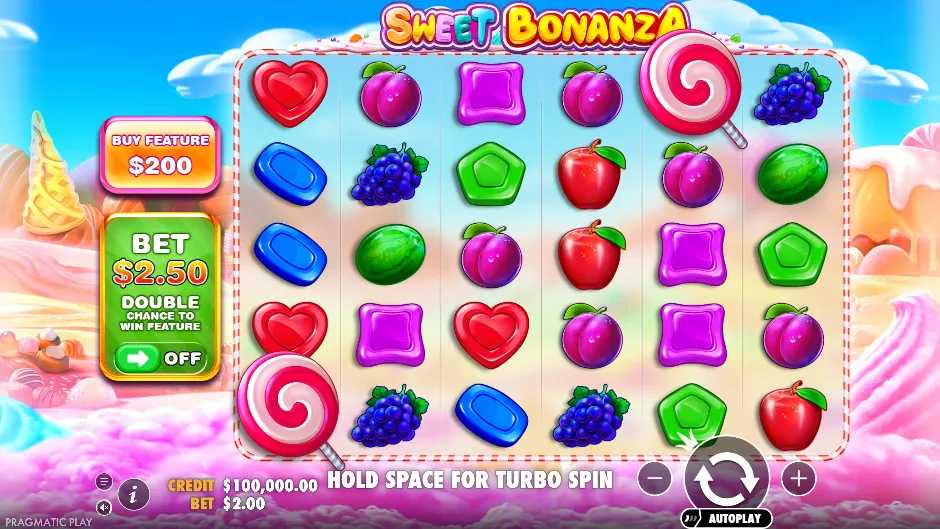
- Board: six columns and five rows. Count identical ordinary symbols anywhere.
- CREDIT and BET: balance and next ordinary stake. The inspected screenshot uses virtual USD.
- Spin and stake controls: the large circular arrow starts play; nearby +/− controls change the stake.
- Information: opens the paytable and game rules. Read the displayed RTP and mode details.
- Feature and Ante: separate paid choices. Read the confirmation cost, not just the ordinary BET label.
The numbered screenshot shows original Sweet Bonanza, not a winning round. The three editions share the basic matching controls; bomb ceilings, purchase choices and RTP differ. Compare the editions. The screenshot balance is virtual credit, not money we deposited. The controls are described for this captured desktop layout; a mobile layout can reposition them while retaining the same labels.
Start by locating the currency. A dollar sign in this demo is not a rand sign. Read the ordinary total stake and whether the Ante switch is active. The left-side R-equivalent price of an enhanced spin or purchase can be much larger than the ordinary amount in the bottom bar. Do not press a large purchase button just to see its artwork without checking the confirmation.
From the screen to a complete Sweet Bonanza result
Check the edition and actual charge
Use the title and BET label on the numbered screen. If Ante is on or you choose a feature buy, read the separate price before confirming. At an R2 reference stake, a 100× buy means R200 charged.
Follow fruit, then tumbles, then bombs
Count at least eight identical ordinary symbols anywhere; touching is not required. Let each winning group disappear and the continuation finish. During the feature, add the applicable bomb values and apply them to that winning tumble sequence.
Subtract the action’s complete price
For an ordinary R2 round returning R5, net profit is +R3. For a purchased R200 feature returning R150, net profit is −R50. These are hypothetical examples. The returned figure alone does not show whether the paid action made money.
To inspect a real control without guessing which release it belongs to, open the Original, 1000 or Super Scatter demo. The illustrated comparison separates bombs, entry awards and caps.
Eight symbols means eight of the same kind
The pays-anywhere rule counts matching ordinary symbols across all thirty positions. You do not have to connect them, draw a line through them or start in the leftmost column. At least eight identical ordinary symbols are needed for the first payout band. The next bands are ten or eleven, then twelve or more. Read the edition’s paytable for the actual amounts.
The counts belong to one symbol type. Four grapes plus four bananas do not make an eight-symbol fruit win. Scatters and bombs have special roles and cannot be added as ordinary fruit. A screen can have more than one paying ordinary symbol at the same time; those awards contribute to the sequence total.
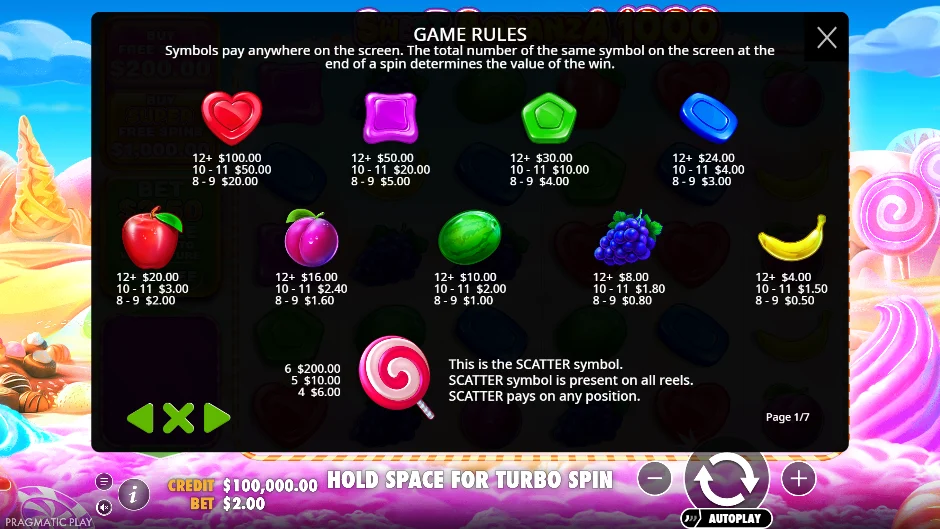
For example, the inspected Sweet Bonanza 1000 paytable pays eight or nine bananas at 0.25× the ordinary stake. At a hypothetical R2 stake that is R0.50. Twelve or more hearts pay 50×, which would be R100 at that stake. The paytable view can display coins or actual cash; converting a coin figure without reading the base-bet scale is a common way to overstate a return.
Walk through a complete ordinary spin
One paid spin. Several tumbles.
A worked example, not a recorded winning round. Switch between the four stages.





Choose a R2 ordinary stake
R2 is charged once for this example. The following tumbles belong to that same paid spin. No ante or feature purchase is included.
- Charged
- R2
- Gross return
- Not settled
- Net result
- Not settled
At Match, eight bananas pay a hypothetical R0.50 at the R2 stake. The later tumble adds R2; total return is R2.50 and net profit +R0.50. The board illustrates only the first match, not a second reconstructed board or server outcome.
The teaching board marks eight bananas spread around the grid. At step two, their hypothetical R0.50 payout is smaller than the R2 stake. Step three adds a second hypothetical R2 payout within the same sequence. The total returned is then R2.50, and after subtracting the single R2 debit the example finishes +R0.50.
There is no extra R2 charge just because the symbols drop again. That distinction is important when reading a game history or recording a sample: one paid round can contain multiple tumble animations. Conversely, an autoplay count of fifty usually concerns paid spins, not fifty symbol removals. The tutorial is arithmetic, not a statistical sample or a server replay.
From lollipops to free spins
Four or more scatters trigger ten free spins in the three covered editions. Three or more scatters during the feature add five more spins. Free spins are part of the round that triggered or purchased them; their cumulative return is not a second deposit into a new account.
During the feature, bomb values can multiply a winning tumble sequence. Original and Super Scatter bombs go up to 100×; the 1000 edition can produce a 1,000× bomb. Multiple bombs add their values before multiplying the sequence amount. The name Super Scatter refers to an additional special trigger rule, explained in its own guide.
A feature can pay less than the charged purchase price. Calling it “free spins” describes how those spins run once entered, not a guarantee that acquiring the feature is free. A 100× or 500× purchase is a separate large debit. Our cost calculator shows the difference between the ordinary stake, purchase price, return and net result.
A sensible first practice session
Use the version’s demo to identify controls and menus before testing speed settings or autoplay. Open the help, examine the ordinary symbol payouts and read the bomb rule. Inspect the purchase choices without treating them as a recommendation. Then, if you choose to practise, keep the stake readable and follow a complete sequence instead of clicking through every animation.
Turbo, quick spin and skipped introduction screens change presentation and pacing. They do not turn an unqualified group of symbols into a win. Faster play can make many paid decisions happen in less time, so it is a poor substitute for understanding the cost of each one.
If an accepted cash round is interrupted, check the operator’s round history and preserve the identifier, stake and approximate time. A frozen animation does not prove that the server rejected the stake. Use the operator’s support channel for settlement questions; this guide cannot access or alter a player balance.
Read a whole paytable without mixing coins and stake
The following atlas transcribes the ordinary-symbol values from the captured Sweet Bonanza 1000 information screen. Its ordinary stake is $2 virtual USD. We divide the displayed award by that full stake to express the ratio, rather than treating a raw coin label as a multiple. This atlas is for the captured 1000 client; it is not an assertion that every other edition or operator configuration has an identical paytable.
Read one row at a time. The three columns are the count bands: eight or nine matching symbols, ten or eleven, and twelve or more. A payout in the first band is not an amount for each of the eight symbols. For example, eight bananas together pay the listed 0.25× award for that group; multiplying it by eight again would count a rule the table does not contain.
Count the layout that exists, not the one it almost made
Pays anywhere means position does not determine whether identical ordinary symbols form a qualifying count. It does not mean every colourful object counts together. Seven bananas plus a lollipop still are not eight bananas. Likewise, four apples and four grapes are not a matching group just because both are fruit. Use the individual symbol rows in the information screen.
After a paying group disappears, look at the replacement layout as the next tumble in the same paid sequence. You may see another group of the same symbol or a different one. Add its actual award to the current sequence once. Do not count symbols from the vanished layout together with symbols from its replacement as though they were simultaneously present on the board.
A final tumble with no ordinary win can still be part of a feature sequence whose earlier wins need a bomb calculation. Follow the client’s sequence total and the rule for the multiplier. The purpose of the slow walkthrough is to keep the objects separate: symbol count determines an ordinary award, the relevant bomb calculation can modify a sequence, and the whole paid cycle settles against its own debit.
Turn the rulebook into a useful five-minute check
Begin with a title check, then open Information before changing a stake. Find one low-value symbol and one high-value symbol and compare their count bands. Switch between any supported coin and cash views only after reading the denomination. A small number in a coin view can represent a different cash amount from the same-looking number in another build.
Next inspect the purchase confirmation without assuming that a feature must be bought to learn the rules. In the original inspected client the purchase is 100× the ordinary stake. The newer 1000 and Super Scatter clients add a 500× Super option. If you choose to practise those modes, read the quoted price and the minimum-bomb condition in that exact client rather than transferring a remembered price from a different game.
Finish by finding the history or final-result view. The useful question is whether you can identify one accepted debit and one completed return for a round, including its tumbles or feature. If you cannot, slow the presentation down or inspect the help again. Speed settings can shorten the time between paid decisions; they do not replace a clear understanding of what each decision costs.
Read two paying symbols on the same screen
Imagine a hypothetical ordinary layout with eight bananas and eight grapes. They are separate paying groups because each symbol reaches its own count threshold. At a R2 ordinary stake, the captured 1000 paytable gives R0.50 for the bananas and R0.80 for the grapes. The combined ordinary award is R1.30 before any later tumble. Sixteen different fruits would not be one larger group; the type and count still have to be read separately.
If the sequence then ends without another award, subtract the R2 debit once: R1.30 returned means −R0.70 net. The two groups paid, but the round did not recover its cost. If a later tumble adds a different actual award, add that amount to the same sequence rather than charging a second ordinary stake. This is why a count of winning groups does not by itself tell you whether a round was profitable.
Now place the same R1.30 subtotal inside a free-spins sequence carrying qualifying 5× and 20× bombs. The combined modifier is 25×, so the sequence return in that invented example is R32.50. Do not immediately subtract R2 and call it the feature’s net profit. The feature may have been entered through an earlier paid spin or a much larger purchase, and its completed return may include several other sequences.
These layouts are arithmetic examples, not captures of observed outcomes. The screenshot supplies the paytable ratios; the invented combinations let you practise reading them. A genuine game result must still be read from the actual sequence and settled history, including any cap. Keeping that distinction visible lets the examples be useful without pretending to be a record of play.
Keep a history note that answers the right question
For an ordinary practice round, note the title, currency, selected stake and whether an enhanced mode is active. After the sequence finishes, note the completed gross return. If you want to explain the symbols, add the counts and component awards underneath as supporting detail. Keep them separate from the final total so that you do not add a cumulative value to its own parts.
For a feature, record how it was entered and the actual cost. Ten starting free spins do not imply ten ordinary debits, and a retrigger does not automatically create another purchase. Read the final feature total after the full cycle, or clearly mark a record as incomplete. A screen showing spins remaining is not the final receipt. No prediction or performance claim should be based on a partial feature.
On a phone, open the original paytable image at full size when the small labels are hard to read. Our numbered control image identifies where Information is located, but the actual loaded client can rearrange controls for the viewport. Find the labelled information control rather than tapping a remembered coordinate. Browser fullscreen or landscape can improve the available space; neither changes the paytable or the next outcome.
If money rather than virtual credit is involved, retain the operator’s round reference and use its history for an unresolved debit or credit. The guide can explain a rule and check an arithmetic example, but it cannot establish an account event it has not observed. For learning the interface, the dedicated free demo is the relevant next page; for an account issue, the operator’s own support is the relevant channel.