
On this page
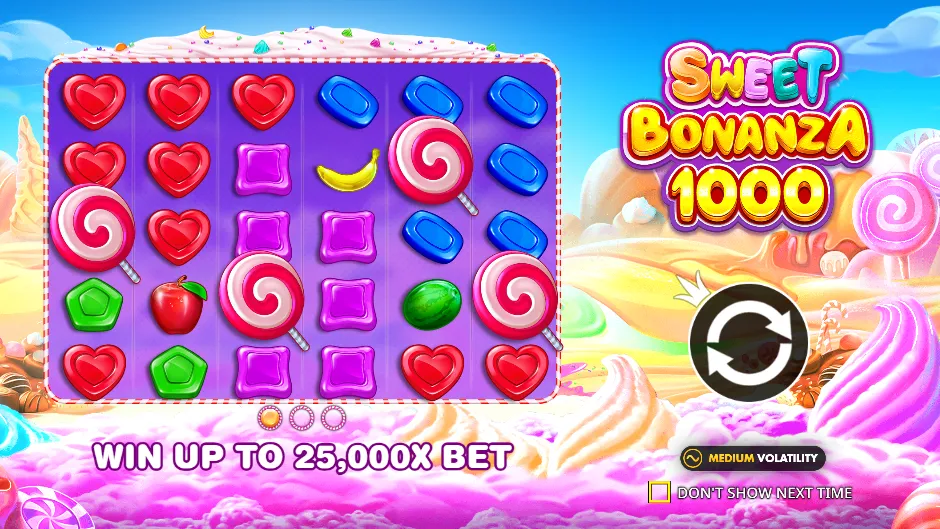
The bigger number belongs to the bomb
Bombs can reach 1,000×. Standard and Super Free Spins have different purchase prices.
Explore partner games18+ · Affiliate link: we may earn a commission. The destination may offer other games; check the exact edition before depositing.
Try this exact edition with virtual credits →How a paid round works
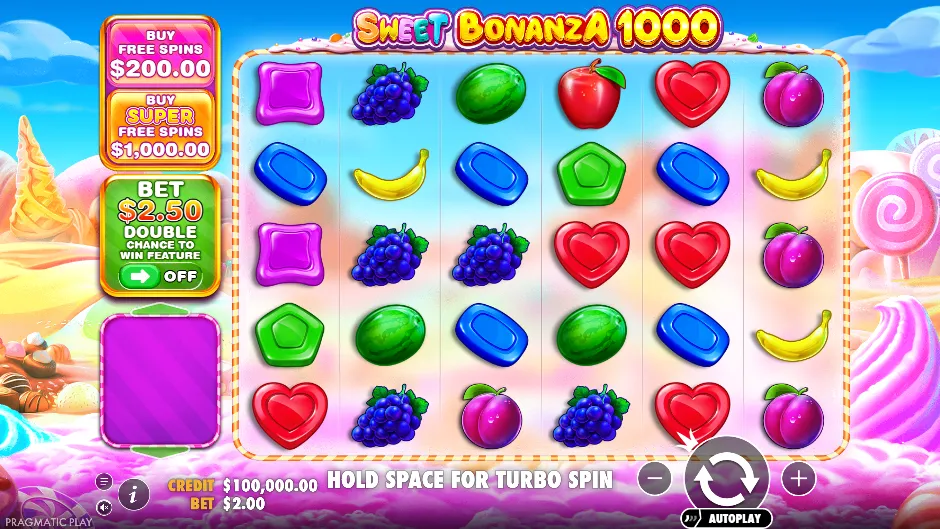
Before spinning, choose the ordinary stake and check whether Ante Bet is switched on. After the paid spin, the game counts identical ordinary symbols across the whole board. A qualifying group pays according to that edition’s paytable. The winning symbols disappear, the rest fall down and fresh symbols fill the gaps. Another qualifying group creates another tumble in the same paid round.
A cluster is not required: eight bananas spread across several columns can qualify. Seven bananas do not become a win just because they touch. Nor can you add five bananas and three grapes together to make eight matching symbols. Each ordinary symbol is counted separately. The lollipop scatter has its own rule and must not be treated as an ordinary fruit.
The complete sequence matters more than any one animated number. If R2 is charged and the finished ordinary round returns R5, the gross return is R5 and the net profit is R3. If it returns R0.80, money has been returned but the net result is still −R1.20. Those are arithmetic examples, not observed spins.
Entering and extending free spins
Four or more lollipop scatters anywhere on the screen start ten free spins. The lollipops have a separate scatter award; normal fruit counts do not substitute for them. During the feature, three or more scatters award five additional free spins. The counter can therefore grow, but it does not guarantee a particular final return.
Bombs appear during the free-spins feature. At the end of the tumble sequence their values are summed and applied to that sequence’s win. They do not act as a multiplier carried forever across every later spin. A non-winning sequence does not acquire a cash payout merely because a bomb is visible.
The easiest way to learn the difference is to inspect the help pages and then follow the tumble total through the sequence. Do not infer the rule from a clipped video showing only the final celebration.
What the multiplier really multiplies
In Sweet Bonanza 1000, a bomb can reach 1 000×. That value is applied to the winning tumble-sequence amount, not directly to the account balance, the feature purchase price or necessarily one ordinary stake. Multiple bomb values add: 5× and 20× produce 25× rather than 100×.
For an illustrative winning sequence worth R3 before bombs, a combined 25× produces R75 gross for that sequence. A 1000× bomb applied to R0.40 would produce R400; that is why the size of the underlying win matters. The total feature may include other free spins, and a round cap can limit the final award.
The bomb ceiling is a possible symbol value, not a payout offered on every feature. We have not measured its appearance frequency or the distribution of returns for this edition. A short run of virtual play would not establish the advertised theoretical RTP.
Modes, costs and the useful comparison
There are two inspected feature purchases: Free Spins at 100× the ordinary stake and Super Free Spins at 500×. The Super purchase sets a minimum bomb value of 20×; it does not guarantee that enough winning symbols will form to recover the purchase cost. At R2, compare a R200 purchase with a R1,000 purchase, not two R2 spins.
Ante Bet changes the paid spin cost from a normal 20-unit configuration to 25 units, a 25% increase. For a R2 ordinary stake that is R2.50. The rules describe an increased natural feature chance, and purchases are disabled while Ante Bet is active in the inspected client. Check the confirmation menu instead of assuming that the smaller base-stake label is the full debit.
To compare two features, write down the ordinary stake, the charged purchase price and the final whole-round return. A 150× base-stake return from a 100× purchase is positive before any other costs; the same 150× return from a 500× purchase is negative. Use the checker to keep the denominator visible.
The configuration we inspected
The inspected 1000 client reports theoretical RTP of 96.53% for ordinary play, 96.50% for Ante, 96.52% for standard purchases and 96.55% for Super purchases. The normal-bet cap is 25,000 times the ordinary stake; the Ante cap is 20,000 times its 1.25-times charged stake.
These are public-demo configuration values, not our observed sample returns or a guarantee that every operator loads the same build. Read the RTP, cap denominators and source differences.
Using this edition in South Africa
Our public demo inspection used USD virtual credits. The rand amounts on this page explain the arithmetic for local readers; they are not a claim that every demo or operator supports every ZAR stake. A listed minimum can vary between game configurations and operators.
At an operator, search the full title, check that Pragmatic Play is the named provider and inspect the game rules inside the actual client. Account access, deposits, identity checks and withdrawals are handled by that operator. This guide has no game account, cash balance or withdrawal form.
If the screen is cramped on a phone, expand the demo or use landscape orientation after it loads. A slow initial download is different from an accepted game round that has not finished. For a cash-account interruption, preserve the round reference and use the operator’s history and support rather than assuming that refreshing cancels an accepted stake.