
On this page
The missing question: multiplied by what?
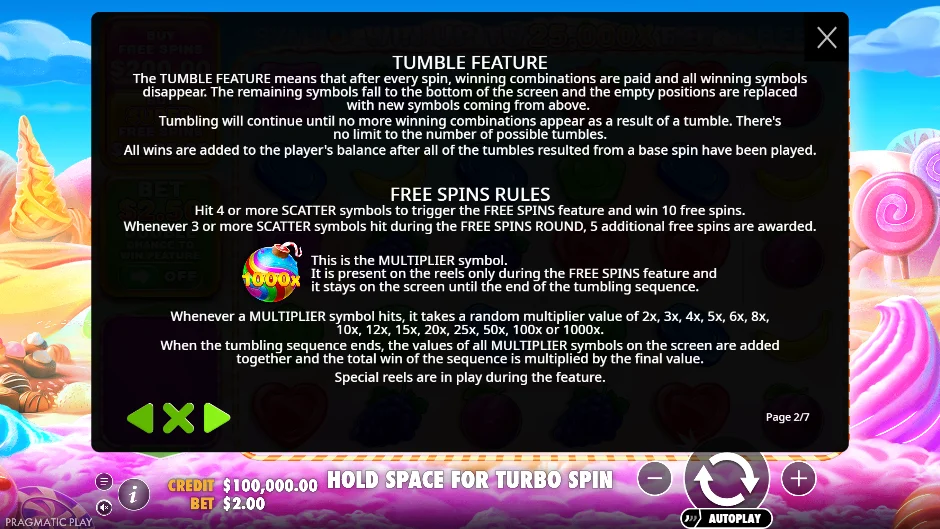
A video can show a large bomb and a much smaller final payout multiple than expected. That does not by itself identify an error. The bomb value multiplies the win accumulated during its tumble sequence. If that win is only a fraction of the ordinary stake, the resulting return can be much smaller than “bomb value times stake”.
Suppose the ordinary stake is R2 and the feature produces a sequence worth R0.40 before bombs. A 100× bomb produces R40 for that sequence, equivalent to 20× the ordinary stake. A 1,000× bomb on the same R0.40 would produce R400, equivalent to 200× the ordinary stake. Both follow the same calculation; the base amount is R0.40 in each case.
Now suppose another sequence has a pre-bomb win of R6 and carries 5× and 20× bombs. Their combined multiplier is 25×, giving R150. It is not 5 × 20 = 100× and not R2 × 25 = R50. The sequence’s own win supplies the multiplication base. These examples are invented arithmetic layouts, not observed game outcomes.
| Worked sequence | Pre-bomb win | Bombs | Gross sequence return |
|---|---|---|---|
| A | R0.40 | 100× | R40 |
| B | R0.40 | 1,000× (1000 only) | R400 |
| C | R6 | 5× + 20× = 25× | R150 |
What carries over, and what does not?
The symbol remains for the tumble sequence described in the inspected rules. The game sums the relevant bomb values when the sequence ends and multiplies that sequence’s total win. This is different from a permanent multiplier saved across every later free spin. Do not carry a 100× from one completed sequence into the next in a personal spreadsheet unless the exact game rules explicitly say so.
The provider’s short Super Scatter marketing description can be read as a longer persistence rule, but the inspected in-game help and its rules PDF specify the end of the tumbling sequence. We use the explicit help wording for the explanation. If a future build changes that rule, its own information screen takes precedence.
A bomb also needs a winning sequence to multiply. A displayed multiplier does not provide a standalone cash award just because its face value is large. Before disputing a missing payment, preserve the complete round result, ordinary stake and sequence total. A cropped bomb screenshot leaves out the denominator and settlement context.
Super Scatter is a different calculation
Super Scatter’s special awards belong to a qualifying scatter trigger. With at least four scatters in total, one special scatter pays 100× the ordinary stake, two pay 500×, three pay 5,000× and four pay 50,000×. Those awards are tied to the stake rather than the ordinary-symbol win accumulated during a tumble.
At R2, a qualifying one-special-scatter trigger means R200, while a 100× bomb on a R0.40 sequence means R40. The same “100×” therefore gives two different cash amounts because it refers to different inputs. Keep the symbol, qualifying condition and calculation base together when explaining the result.
The separate Super Free Spins purchase in 1000 and Super Scatter sets the minimum bomb value to 20×. It does not replace the need for a winning ordinary-symbol sequence. It is a purchase mode, not the special scatter itself, and it does not create the 1000 edition’s 1,000× bombs in Super Scatter.
Read the final receipt, not only the animation
For a bought feature, add the whole feature return and subtract the actual purchase debit. A R150 sequence inside a R1,000 feature is not +R150 profit. Other sequences may add to the total, but the complete feature must return more than R1,000 to finish positive in that simple example.
Use history to identify the whole paid cycle. One triggered feature can include its initial scatter award, the starting free spins and retriggers. Do not count those pieces as separate deposits or ignore the initiating stake. Record the final return once, alongside its actual cost.
The maximum round cap can stop a large theoretical calculation from being fully paid. Normal and Ante modes can have different cap ratios relative to the charged stake. A calculator that ignores a cap should describe its result as uncapped arithmetic, not an authoritative settlement prediction.
Find the beginning and end of the amount being multiplied
A sequence begins when a spin produces its layout and continues through the tumbles that follow. The game can show an award for one group, another award after symbols fall, and a running total for the sequence. These are not three independent balances. Before applying a bomb calculation, identify the subtotal the rules say is being multiplied. Using an earlier small group instead of the whole relevant sequence understates the result; multiplying a total that already includes the bomb overstates it.
For an invented feature sequence, imagine ordinary-symbol awards of R0.50 and R1.50 before the bomb calculation. The relevant combined amount is R2. A 5× and a 20× bomb add to 25×, producing R50 for that sequence. Counting R0.50, R1.50, R2 and R50 as four returns would double-count the same components. The game’s history or settled cycle is the place to resolve whether a displayed figure is a component or a cumulative total.
The sequence boundary also prevents a different error: carrying a bomb into a later free spin just because it remained visible during the previous animation. The inspected rules describe persistence to the end of the tumbling sequence. A new free-spin sequence must be read on its own terms. The feature’s total return can accumulate across spins without every bomb becoming a permanent feature-wide multiplier.
This is why an isolated celebration screen is a poor calculation worksheet. It may show a feature total after several sequences while the visible bomb belongs only to the last one. You cannot reconstruct all preceding awards by multiplying that last bomb by the final total. Preserve the whole result and the ordinary stake; use individual frames to explain a known calculation, not to invent missing events.
Three common misreadings, corrected with the same numbers
First, a bomb face value is sometimes read as a cash amount. At an ordinary stake of R2, a 100× bomb does not automatically pay R200. It pays R200 only if the relevant pre-bomb sequence amount is R2. If that amount is R0.40, the same 100× gives R40. The multiplier is unchanged; the input to the multiplication is different. Read both values before deciding that the game paid too little.
Second, several bombs are sometimes multiplied together. With 5× and 20×, that would incorrectly give 100×. Their sum is 25×. At a R2 sequence amount, the correct arithmetic example is R50, whereas the mistaken operation would predict R200. This is an operation error, not a difference in currency or a hidden fee. The helper below the headline should never replace the actual help page for the selected edition.
Third, a player can subtract the ordinary stake after paying for a feature. If a R1,000 Super purchase returns R400 in total, the net transaction result is −R600, even if one sequence inside it contained a 1,000× bomb. Subtracting R2 would instead produce a misleading +R398. A correct bomb calculation and an incorrect purchase-cost calculation can occur in the same explanation, so verify them separately.
When a video calls a result “1,000×”, ask whether that refers to a bomb, the complete return divided by ordinary stake, or the complete return divided by purchase price. The same phrase can hide three different quantities. A useful record writes the amount in currency or credits and labels the ratio explicitly. That makes the explanation reproducible without needing to trust the narrator’s choice of words.
A trigger award needs a trigger, not just a symbol
In Super Scatter, the qualifying feature-entry condition is essential to the special award. Read the total number of scatter-type symbols first, then count the Super Scatters in that qualifying combination. The ordinary and special scatters can contribute to the required total. Seeing a special symbol in a crop does not establish that the full trigger condition was satisfied.
At a hypothetical R2 ordinary stake, a qualifying one-special-scatter entry award is R200. That calculation starts from the ordinary stake. A 100× bomb on a R0.40 winning sequence produces R40 instead. Putting the two examples side by side explains why the same multiplier label cannot be applied without naming the symbol and the calculation base. Neither example supplies the probability of the event.
An entry award and the subsequent free spins also need accounting boundaries. If a final history total includes the trigger award, adding it a second time overstates the round. If a display instead separates that award from a later feature subtotal, read the labels before combining them. This guide does not assert the inclusion rule of every operator history format; retain the actual settled record rather than guessing from its layout.
What to preserve when a result looks wrong
Record the exact edition, mode, ordinary stake, actual debit and whole-cycle gross return. If the question concerns a bomb, preserve the relevant sequence subtotal and the bomb values as well. A round reference and approximate time help an operator locate an account event. A screenshot of a large symbol without the underlying win is much less informative.
Then separate an arithmetic question from a settlement question. You can check that 5 plus 20 equals 25 and that R2 times 25 equals R50 without knowing the server’s random process. You cannot establish that every intended stake was accepted, or that a cash account was credited correctly, from that arithmetic alone. The operator’s round history and support handle those account-specific facts.
Finally, keep the limits of the evidence in the conclusion. A correct example teaches how a future result should be read; it does not reveal that result in advance. A genuine large win proves that one recorded outcome occurred, not that a waiting rule or a larger purchase will reproduce it. The useful habit is to ask what each number measures before treating it as a reason to play.
A correct multiplication can still be an incomplete result
Round caps apply after you have identified the correct arithmetic. If an uncapped teaching calculation exceeds the configured limit, the multiplication alone is not a settlement prediction. The rules can stop the feature at that limit and forfeit remaining spins. Conversely, a calculation far below the limit does not become more likely because there is unused room above it. The ceiling bounds a result; it does not distribute outcomes across the available space.
Another boundary is the complete feature. A R32.50 sequence can be one contribution to a longer feature with other winning or non-winning spins. To evaluate that sequence’s multiplication, use its own subtotal and bombs. To evaluate the feature’s net result, use all of its settled return and the initiating price. Neither calculation replaces the other, and neither establishes a session result that also includes earlier ordinary rounds.
A helpful worksheet therefore has separate lines for the pre-bomb sequence amount, combined bomb value, sequence return, complete feature return and actual debit. Leave an unknown field blank rather than trying to infer it from a celebration. You may be able to check the sequence calculation while still being unable to establish the full net result from the evidence available.
That is a useful conclusion in its own right. A guide should be able to say which part of a result is explained and which part still needs the complete history. Filling the missing space with an assumed stake, an unobserved feature total or a promise about the next bomb would make the explanation look complete while making it less reliable.