
On this page
Bomb value, Super Scatter award and round limit: three different calculations
A bomb multiplies the winning sequence
In 1000, a possible 1,000× bomb applied to a hypothetical R0.40 winning sequence gives R400 gross for that sequence. A 100× bomb applied to R0.40 gives R40. The bomb does not multiply the account balance or the price of the feature. Neither example measures how often that bomb appears.
Follow the bomb calculation →Super Scatter uses the ordinary base stake

At a hypothetical R2 ordinary base stake, a qualifying trigger with one Super Scatter pays 100 × R2 = R200 as its entry award. It needs the complete qualifying combination of at least four total scatters, including that special symbol. A lone Super Scatter without that combination does not establish this award.
Read the complete Super Scatter conditions →A cap limits the round; it is not another multiplier prize

The inspected 1000 normal-bet cap is 25,000× the stake; Super Scatter has a 50,000× normal-bet cap. At an illustrative R2, those ceilings correspond to R50,000 and R100,000. They are limits, not expected returns. Do not add a cap on top of a trigger award as if both were independent guaranteed payments. The original introduction’s advertised “over 21,100×” is not presented as a captured configured cap.
Check version and mode limits →| At the same R2 reference stake | Original | 1000 | Super Scatter |
|---|---|---|---|
| Standard feature purchase | R200 | R200 | R200 |
| Super feature purchase | Not in inspected menu | R1,000 | R1,000 |
| Largest listed bonus bomb | 100× | 1,000× | 100× |
| Separate Super Scatter entry award | No | No | Conditional on qualifying trigger |
The equal reference stake does not make all selected actions equal in cost. One R200 purchase fits an R300 example budget, leaving R100 before any return. An R1,000 purchase does not fit. Use the full-price calculator before comparing a feature’s settlement with an ordinary spin.
| What changes? | Original | 1000 | Super Scatter |
|---|---|---|---|
| Bonus bomb values | 2–100× | 2–1,000× | 2–100× |
| Published headline / inspected cap | Over 21,100× advertised; configured cap not captured¹ | 25,000× normal bet | 50,000× normal bet |
| Starting free spins | 10 | 10 | 10 |
| Retrigger | 3+ scatters → +5 spins | 3+ scatters → +5 spins | 3+ scatters → +5 spins |
| Feature purchases inspected | 100× | 100× / 500× | 100× / 500× |
| Special scatter instant award | No | No | 100× / 500× / 5,000× / 50,000× |
| Demo currency inspected | USD | USD | USD |
¹ The original’s 21,100× is the advertised introduction headline, not an authenticated player record. Normal-bet caps and purchase modes are shown for the inspected builds. Ante configurations can have different cap denominators. See the limits and RTP explanation before comparing screenshots.

Sweet Bonanza
Fruit, candy and the original 2–100× bonus bombs. Start here to learn the tumble.
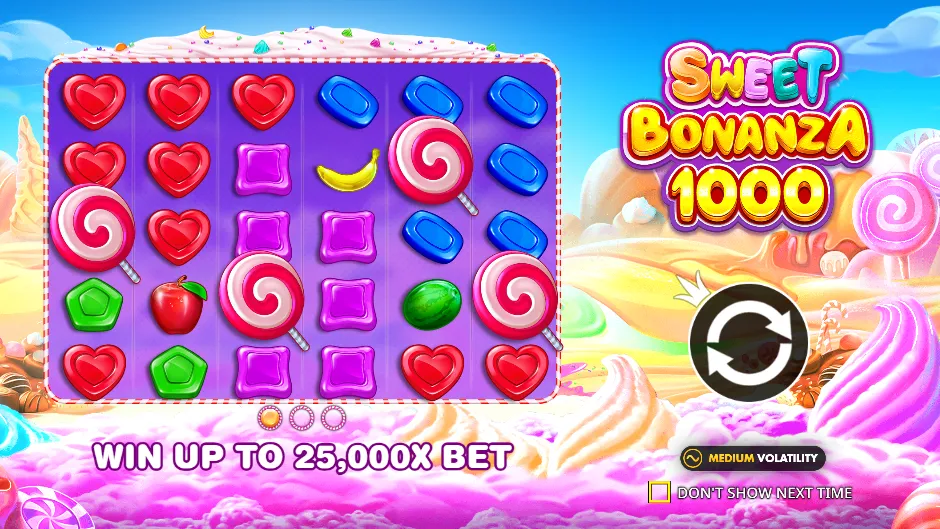
Sweet Bonanza 1000
Bombs can reach 1,000×. Standard and Super Free Spins have different purchase prices.
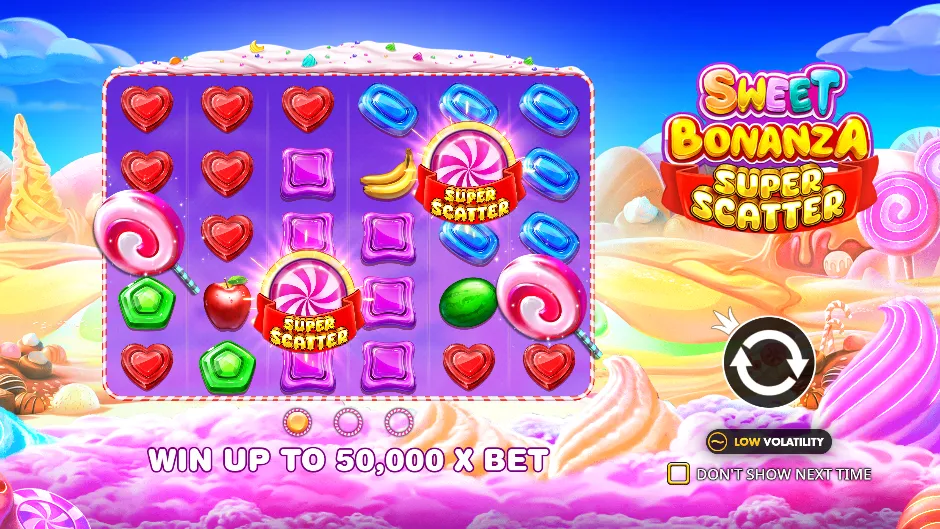
Sweet Bonanza Super Scatter
Special scatters add an instant trigger award. Bonus bombs still reach 100×, not 1,000×.
The mechanics that stay the same
All three editions use a six-by-five board and pay for eight or more matching ordinary symbols anywhere. They use tumbles, so a winning layout can lead to another layout without another ordinary stake. Four scatters are the normal starting point for ten free spins, and three scatters within free spins add five more. These shared rules explain why the games initially look so similar.
The shared appearance also creates mistakes. None of these three slots uses a fruit-cluster adjacency rule. A bomb is not a substitute for the eighth banana. Nor is a scatter counted as a fruit to complete a normal payout. Inspect the paytable for each symbol and the help page for the feature before transferring assumptions from another candy-themed slot.
The two differences people mix up most
Sweet Bonanza 1000 increases the possible individual bomb value to 1,000×. Super Scatter instead adds a special kind of scatter to the feature trigger. Its regular bomb ceiling is 100×. A video title using “super scatter 1000” can blur these names, but it does not create an official combined edition.
The second confusion is between Super Scatter and Super Free Spins. Super Scatter names a game and its special trigger symbol. Super Free Spins names a 500× purchase available in both the 1000 and Super Scatter clients inspected. Its 20× minimum bomb is a feature condition, not a guarantee of a large final return.
A larger maximum win also tells you little about the path to a normal-sized payout. Two distributions can have similar theoretical RTP while placing very different proportions of that return in rare outcomes. We have not collected an audited comparative sample, so this guide does not rank the games by observed profitability.
Compare them at the same charged cost
Suppose your ordinary stake is R2. The normal spin costs R2, an Ante spin costs R2.50, the standard purchase costs R200 and a Super purchase costs R1,000. Comparing a R250 celebration after an ordinary spin with a R250 return after the Super purchase hides the most important difference: the first is +R248 for that round; the latter is −R750.
An edition comparison should therefore record the exact title, RTP configuration, mode, ordinary stake and actual debit. Compare gross returns only after agreeing on the denominator. A 100× return of the ordinary stake is not the same as a 100× return of a purchased feature’s price.
Identify the game before opening an account
Read the actual title inside the client, preferably on the introduction or Information page. A lobby thumbnail can be cropped, stale or too small to show the suffix. Provider identity matters too: Sweet Bonanza CandyLand is a live game with a different format, not the original slot with a different background.
The version finder below sends the three covered titles to their guides. If you choose another title, it explains that the rules here do not establish that game’s features. We have not silently reused one demo for all names.
Choose the feature you actually want to understand
The original is the clearest starting point if your question is how fruit counts become tumbles and how a bonus bomb changes a sequence. It has fewer purchase choices to distinguish in the inspected menu. That makes the explanation shorter; it does not establish a safer session, a better chance of recovering a purchase or a minimum amount of play from a budget. Its introduction and RTP help should still be read rather than replaced with a description of the newer releases.
Choose the 1000 guide when the question is specifically about larger possible bomb values. The important addition is a possible 1,000× bomb during the feature, alongside the standard and Super purchases. The number does not describe the frequency of that bomb, a starting balance or an amount available on every bonus. Someone who opens 1000 to find the special scatter trigger is looking in the wrong rulebook, even though the candy artwork looks familiar.
Choose Super Scatter when you want to understand the special symbol and its conditional entry award. The special scatter changes what can be paid when a qualifying feature trigger forms. Its regular bombs still stop at 100×. The larger normal-mode round cap belongs to a different part of the rules than the 1000 edition’s larger bomb ceiling. These are two different design changes, so there is no single larger-number winner.
This is a choice between mechanisms, not a ranking of how much money a reader should expect to make. We have not measured a comparable return distribution for the three games. A reader who wants the largest possible symbol, someone interested in trigger awards and someone simply learning the controls can therefore need different pages without any of them having found a profitable game. The dedicated demos let you inspect each exact client before making an account decision.
The limitations worth noticing before the colourful part
The original offers fewer feature-purchase choices in the inspected client. If your aim is to practise the 500× Super Free Spins menu, the original cannot answer that question. Its familiar name can also hide the fact that a search result is about a later edition. Read the suffix inside the game, not just the name of a lobby category. A menu option that does not exist should not be inferred from a video of a similar board.
The 1000 edition adds a larger possible bomb, but the underlying sequence still needs something to multiply. A 1,000× symbol applied to a very small pre-bomb win can produce a return below the feature purchase cost. That is the practical weakness of judging it from the bomb alone: the screenshot can make the number look decisive while omitting the winning-symbol subtotal and the debit. Our multiplier article works through those missing inputs.
Super Scatter adds another condition to recognise correctly. You need the qualifying total of scatter-type symbols and the count of special scatters within it. A lone special symbol is not permission to apply the top award. The special scatter also does not appear during the free-spins round in the inspected rules. Expecting it on every later bonus spin would turn an entry mechanism into a feature that the game does not offer.
The two newer games also present a choice between standard and Super purchases. More choice means more prices and conditions to read. An expensive purchase can be perfectly well explained by its rules and still be unsuitable for a particular spending allowance. The guide therefore keeps the purchase price next to the ordinary stake rather than praising the presence of another button as an improvement in value.
Compare a complete receipt, not the brightest frame
A fair comparison begins with the transaction you are buying. For an ordinary round, the debit is the accepted spin stake. For an Ante round, it includes the enhanced price. For a bought feature, it is the entire confirmation price, even though the game continues to display the smaller ordinary stake as a reference. Write the mode beside the amount before comparing a result with another edition.
Consider three hypothetical R2 reference-stake receipts, each with R150 returned. After a normal R2 spin, the transaction is +R148. After a 100× purchase costing R200, it is −R50. After a 500× purchase costing R1,000, it is −R850. Those examples do not say the three actions are equally likely to return R150. They hold the return constant to reveal why the denominator changes the conclusion.
Now consider a feature described as a 150× win. If that multiple refers to the ordinary R2 stake, the return is R300. It is not R30,000 just because the feature cost R200. A result displayed in base-stake multiples and a result displayed as a return on purchase price answer different questions. Keep the actual cash or virtual-credit amounts in the record so that the labels cannot silently change the arithmetic.
The final feature total may already include an entry award and earlier winning sequences. Do not add the same award again after reading a running total. If the history supplies a whole-cycle return, compare that once with the initiating debit. Screenshots can help identify the mode, but the complete record is the better place to establish the transaction’s gross return and net result. See the purchase guide for the full calculator and confirmation examples.
What the headline numbers cannot decide for you
A maximum describes a boundary, not the chance of reaching it. Without the outcome distribution, a 50,000× normal-mode cap does not tell you how often the game returns more than its stake. Nor does the original’s advertised headline establish that it will deliver more small wins or keep a particular budget going for longer. Those would be separate measurable claims. We do not derive them from an attractive limit.
The RTP comparison needs the same discipline. The captured original help gives a minimum and maximum without a mode mapping, while the two newer configurations supply mode-specific values. Choosing the largest number from those different sources would not be a like-for-like comparison. Read the actual client and selected action. A theoretical percentage is not a promise that a short demo or cash session will finish near it.
For a practical final choice, answer three questions in order: which exact title is open, which feature or control do you want to use, and what will that action charge? Then check the operator’s current availability and terms. If any of those answers remains unclear, the useful next step is the relevant guide or demo, not a larger stake. The comparison earns its place by making that next step specific, rather than declaring one edition universally best.
Use the same standard of evidence for each edition
A useful comparison should say when a number comes from a product-page headline and when it comes from the client you can actually open. The original’s advertised maximum and its unassigned RTP range are not equivalent to a complete mode-by-mode configuration. Leaving that difference visible is more informative than filling every table cell with a confident-looking number taken from another build.
The same principle applies to availability. A local lobby card establishes that a title is listed in a public catalogue. An operator-hosted rules PDF establishes that a document exists. Neither alone proves that your signed-in account can launch every mode, that its current stakes match the public demo, or that an operator promotion includes feature purchases. Our where-to-play page keeps those levels of evidence separate.
For a quick final check, keep the game title, provider name and selected mode together in one note. Add the ordinary stake, displayed currency and actual confirmation price. If you compare two screenshots later, those details reveal whether you are comparing the same action. If one screenshot omits the mode or price, treat its apparent advantage as unresolved rather than letting the larger win caption decide.
This checklist also makes the demo useful without turning practice into a promise. You can learn where the controls are, distinguish the feature choices and read the help before using an account. You cannot use a virtual win to verify a payment route or prove that a session with cash will repeat it. The next action should match the question you have actually answered.